A marketing director I respect demoed me a tool last week that claimed to use AI to write entire email sequences from a one-sentence brief. The demo was beautiful. The output, when we ran it against a real ICP brief from one of his customers, was a brochure-grade pile of generic claims that would have been embarrassing to send.
This is the state of AI in email marketing right now. I'm convinced that 90% of what's pitched as AI is just clickbait wrapped in a product UI. The other 10% is the most interesting thing to happen to email since deliverability filters got smart — and the broader picture, well-documented in the annual State of AI report, is that the gap between demo capability and production reliability is wider than anyone selling pitches will admit. The job, for everyone buying or building marketing software in 2026, is telling those two apart before you put one in front of your list.
Why the AI hype cycle hits email marketing harder than other categories
Email is the most demoable category in martech. The output is text, the inputs are short, and the bar for "looks impressive" in a five-minute pitch is comically low. Anyone can wire a large language model to a subject-line generator, plug it into a sandbox account, and produce a screenshot deck.
That's why your inbox — both the one you send to and the one you receive from — is full of features that work in the booth and break in production. The features that survive contact with real lists are a much smaller set. Here's how I sort them.
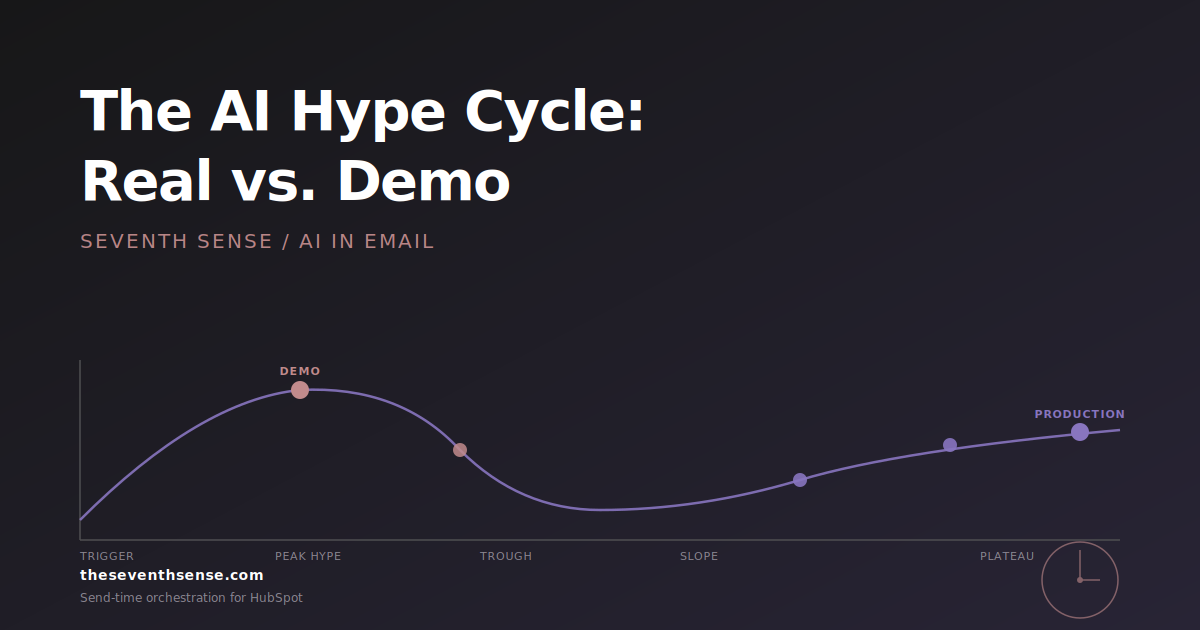
The Gartner-style hype curve for AI email features in 2026
The framing isn't novel — Gartner's research methodology has been the standard lens for new tech categories for years — but it maps unusually cleanly to where AI email features sit right now. Plot any AI email feature on this curve and you'll know what to do with it:
- Peak of inflated expectations. Autonomous campaign agents. AI-generated personalized video. Real-time generative subject lines per recipient. These get the keynotes. None of them is shipping measurable lift at scale yet.
- Trough of disillusionment. Generic AI subject-line writers, "smart" send-time tools that just pick 10 a.m. on Tuesday, AI copywriting tools that produce passable middle-school book reports. Marketers tried these in 2023-2024 and quietly turned them off.
- Slope of enlightenment. Recipient-level send-time models, deliverability anomaly detection, content-fatigue prediction, over-messaging tracking. These are doing real work in real portals.
- Plateau of productivity. Spam-filter learning models, mailbox provider scoring, subject-line A/B significance testing. Boring, invisible, foundational. Most marketers don't even think of these as AI anymore.
The pattern: the AI that actually moves numbers tends to be invisible. The AI that gets pitched tends to be visible. Inverse correlation between demo quality and production value is the single most useful rule of thumb I've found for evaluating this category.
Demo-only versus production-ready: the four tests
When a vendor shows me an AI feature, I run it through four questions before I take it seriously. None of these is original. All four together are surprisingly effective.
1. Does it have a meaningful integration with the data?
An AI feature that doesn't read your historical send data, engagement history, or recipient behavior is, at best, a fancy autocomplete. Real AI in email marketing requires data depth. If the demo works with a fresh sandbox account and no historical context, it will work the same way in production — which is to say, not at all.
2. Can the vendor show me the variance reduction, not the average?
Every AI vendor will tell you their feature improved open rates "by 23%." Almost none can tell you what happened to the bottom quartile of recipients. The bottom quartile is where deliverability damage actually happens. If the vendor can't show variance, they're showing you a cherry.
3. What happens when the model is wrong?
Production-ready AI fails gracefully. It defaults to a sensible baseline, surfaces uncertainty, and lets a human override. Demo-ware fails confidently — it ships the wrong subject line to your largest customer with full conviction. Ask any AI vendor what their fallback behavior is. The good ones have a thoughtful answer. The bad ones change the subject.
4. How long has the feature been in production?
AI features that ship in week one and get keynote slots in month two are demos. AI features that have been live for 18 months, gotten boring, and quietly print value are production. There's no shortcut around time-in-market for this category.
What's actually working in AI in email marketing right now
Setting aside the hype, here's what I see working in real B2B HubSpot portals in 2026:
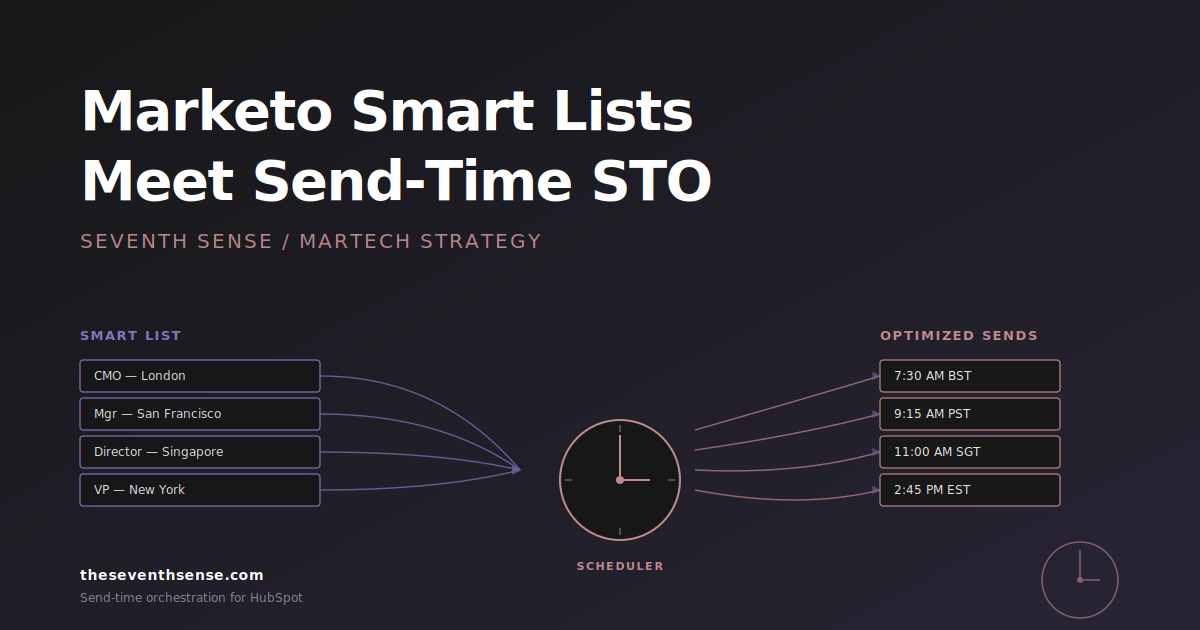
- Recipient-level send-time models. Not "best time to send for your audience" — that's a 2017 idea. The current generation models each recipient's behavior independently and schedules accordingly. This is what our scheduler has done since 2019, and the proof on send-time optimization in HubSpot is now well-documented across portals.
- Deliverability anomaly detection. AI watching your sender reputation signals and alerting before the mailbox providers do. Lower-glamour than generative anything, but the highest-ROI AI investment most B2B teams can make.
- Over-messaging and content-fatigue prediction. Models that recognize when a recipient is about to disengage based on send cadence and content overlap — the same dynamic I covered in the post on over-messaging as the silent deliverability killer. We shipped a version of this in April 2026 as part of our Analytics UI enhancements, and it's quickly become the feature audits start with.
- Subject-line significance testing. Not subject-line generation. Significance testing that uses Bayesian methods to call A/B winners faster and more reliably. Unsexy, very valuable.
What's still mostly demo-only
And here's what I'd hold off on, even though every vendor pitch deck has one:
- Fully generative email body copy. The output is generic enough that it actively damages your brand voice. Useful as a first-draft tool for a human; dangerous as an autopilot.
- "Autonomous agent" campaign builders. Marketed as set-and-forget. In practice, they require more babysitting than a manual workflow because their failure modes are non-obvious.
- Real-time per-recipient subject-line generation. Sounds amazing. Produces subject lines that get flagged as spam at higher rates than your control because they look algorithmically generated to mailbox providers — which is exactly what they are.
- AI-personalized images and video at scale. The compute cost-per-send wipes out the lift. The compliance review wipes out what's left.
How to evaluate any new AI email feature in five minutes
Here's the cheat sheet I use when I'm in a vendor demo and trying to figure out which side of the curve a feature is on. Ask, in order:
- "Show me a customer who's been using this for over a year."
- "What's the variance in lift across the customer base, not the average?"
- "What does the model do when the data is sparse?"
- "Walk me through a failure case you've seen in production."
If the vendor has good answers to all four, you're looking at a production-ready feature. If three of the four answers are some version of "great question, let me follow up," you're looking at a demo that hasn't lived long enough to be honest with itself yet.
Frequently asked questions about AI in email marketing
Is AI in email marketing worth investing in right now?
Yes — but specifically in the categories that have moved past the demo phase: recipient-level send-time optimization, deliverability anomaly detection, over-messaging tracking, and A/B significance testing. Hold off on autonomous agents and fully generative bodies until they've spent more time in production.
How do I know if an AI feature is just a wrapper around ChatGPT?
Ask the vendor what proprietary data the model trains on. If the answer is "we use a large language model and your account data as context," it's a wrapper. Wrappers can be useful, but they're rarely defensible and rarely worth premium pricing.
Will AI replace email marketers?
No. AI is shifting the work, not eliminating it. The marketers who get the most leverage from AI are the ones who use it for the unglamorous backend — orchestration, deliverability, fatigue prediction — and keep humans on the creative and strategic decisions where judgment still beats statistics.
What's the single AI feature that pays back fastest in a HubSpot portal?
Recipient-centric send-time optimization, by a wide margin — and specifically the first-hour engagement window work that compounds across deliverability and pipeline. It's the AI category with the longest production track record, the clearest measurement story, and the most direct line to revenue. Everything else is a second-tier investment until that one is in place.
Where to go from here
The temptation in AI right now is to keep trialing new things in the hope of stumbling onto a breakthrough. The more reliable move is to deploy the boring, proven AI in the parts of your stack where it's already paying off — and let the hype cycle run its course on the rest.
If you want to see what production-grade AI looks like inside a HubSpot portal, the free trial of Seventh Sense connects in about 15 minutes and starts modeling your recipients individually from day one. No autonomous agents. No generative anything. Just the AI that ships results.
See what your email program could be doing.
Connect Seventh Sense to your HubSpot portal and watch the AI surface per-person engagement profiles, per-inbox-provider performance, and AI-driven optimization recommendations - within 24 hours.
Try it free →