A few years ago, I was on a quarterly review call with a CRO who'd just been handed the marketing function. He pulled up the dashboard, looked at the database size, and said: "Cut it in half. I want this list pruned by end of quarter." His marketing director, sitting next to me, looked like she'd been asked to set fire to the building. Six months later, the list was half the size, the open rate had doubled, the pipeline was down 30%, and the CRO was now blaming the macro environment in his board update.
That's the pattern. Pruning produces a visible win on a dashboard and an invisible loss in the pipeline, and by the time the loss becomes visible, three other things have changed and no one can attribute the damage. A real cold contact email strategy doesn't start with scissors — especially when the mailbox-provider data via Google Postmaster Tools shows that engagement, not list size, is what drives placement. It starts with the question: which of these contacts are genuinely dead, and which are just quiet right now?
Why pruning is the most overrated email tactic
The Hygiene Hawks — the camp I described in an earlier post on the list management framework that suppresses aggressively to protect deliverability — treat pruning as the responsible adult choice. It has a moral weight to it. "We don't want to spam people who aren't interested." That framing makes pruning feel virtuous, which is why it's so hard to argue against.
Here's the problem: pruning conflates three different populations into one decision.
- The genuinely dead. They left the company, changed careers, or were never a good fit in the first place. Pruning them is correct.
- The merely quiet. They're still in your ICP, still at the company, still receiving your sends — they just aren't opening this quarter because their priorities shifted. Pruning them is a mistake.
- The selectively engaged. They open your product update but not your nurture, or they read your CEO's posts but ignore your webinar invites. They're showing you which content matters; pruning them is a misread.
A pruning rule that triggers on "no opens in N days" treats all three populations identically and suppresses all of them — and post-MPP, "no opens" is an increasingly bad proxy for "no engagement," as I covered in the post on the 90-day inactivity rule. The first group should be suppressed. The second should be re-engaged at lower frequency. The third should be re-segmented into the content they actually want. Lumping them together is what makes pruning a blunt instrument.
The Start-Up Seller's version of the same mistake
I've written about the Big Brand Blaster — the enterprise marketer who blasts everyone forever. Pruning is the opposite archetype's mistake. I call them the Start-Up Seller: a small marketing team at a Series A or B SaaS company, told to "stay lean," running on a HubSpot Professional seat with one person managing the entire list. The Start-Up Seller prunes aggressively because she doesn't have the bandwidth for a re-engagement campaign and because every contact above her HubSpot tier's marketing-contact limit is costing real money.
Her math is reasonable in the short term. She saves $400 a month by staying under the next tier. The contacts she pruned would have produced maybe one or two opportunities this quarter, none of which she can prove ex post. The savings show up in the next finance review; the lost pipeline doesn't show up anywhere.
The principle the Start-Up Seller misses is this: cold contacts have option value, and option value compounds. A contact who downloaded a comparison guide eighteen months ago and went quiet is not worth zero today, even if your open rate report shows them as inactive. They're worth whatever the probability is that they re-enter the buying cycle in the next year, multiplied by your average deal size. For most B2B SaaS products, that number is well above the marketing-contact cost of keeping them.
What top HubSpot teams do instead
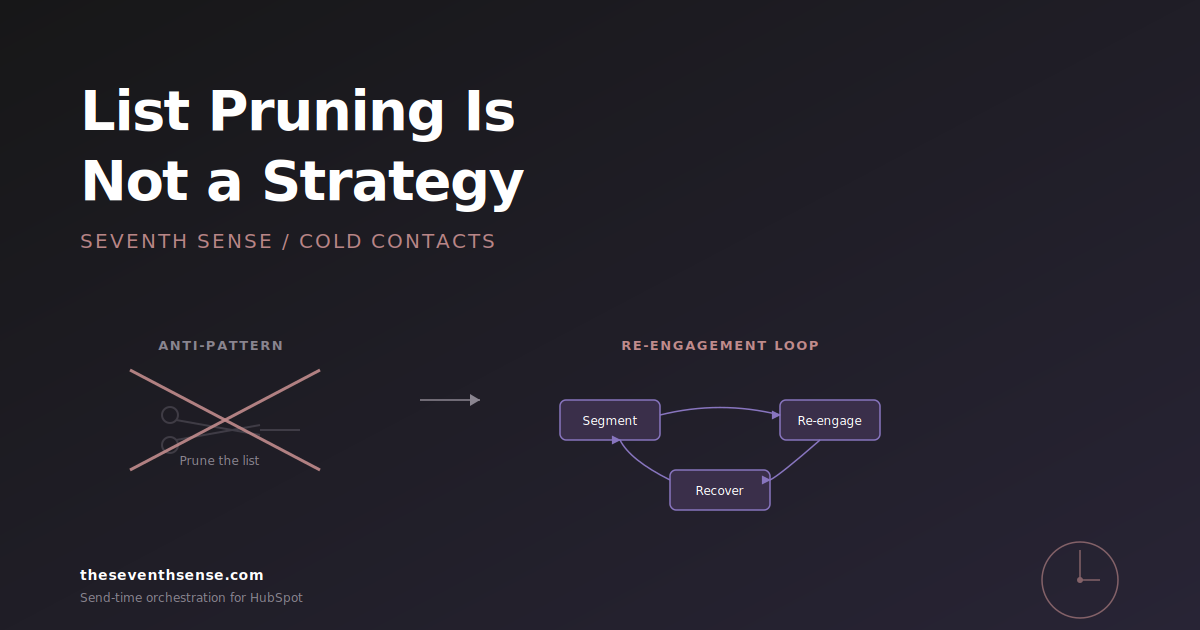
The teams I see managing cold contacts well don't use one technique — they use a sequence of three, applied in order, with the cheapest interventions first.
Segmented re-engagement
Cold contacts go into a re-engagement flow segmented by what they originally engaged with. The contact who downloaded a security whitepaper two years ago gets a security-themed re-engagement — new research, a customer story, a "what's changed since 2024" framing. The contact who attended a webinar on integrations gets a re-engagement about the new integrations you've shipped. Templated "we miss you" emails get ignored; content that matches the original interest gets opened.
This is more work than a generic re-engagement campaign. It's also where the recovery rate is two to three times higher in the portals I audit. The investment is in the segmentation, not the send.
Low-frequency win-back
After the initial re-engagement campaign, contacts who didn't respond don't go straight to suppression. They go into a low-frequency win-back pool — one carefully chosen send per month, focused on original research, product launches, or industry milestones. The cadence is low enough that you're not hurting your engagement ratio. The content quality is high enough that the contacts who eventually come back recognize the brand instead of treating it as spam.
This stage usually lasts six to twelve months. The recovery rate per month is low, maybe 1-2%, but it compounds. Over a year, you'll re-engage another 10-20% of the contacts who didn't respond to the initial campaign. The mechanics here overlap with the graymail suppression vs. re-engagement decision — suppression is final, recycling preserves option value. That's pipeline you would have lost entirely under a pruning model.
Genuine death identification
The last step — and the one that finally justifies suppression — is identifying contacts who are genuinely dead versus the merely quiet. The signals that matter here are not the ones most teams use:
- Hard bounces. If a contact's email has bounced repeatedly with a "user does not exist" response, they've left the company. Suppress. (Gmail's sender guidelines are clear that repeated hard bounces actively damage sender reputation.)
- Domain abandonment. If the contact's company domain stops responding entirely across multiple contacts, the company is likely defunct or has migrated. Suppress.
- Verification failure. Periodic email verification via a third-party tool will catch dead addresses that haven't bounced yet. Suppress the failures.
- Absolute silence for 18+ months. No opens, no clicks, no site visits, no form fills, nothing from the re-engagement campaigns. At this point, you've genuinely earned the suppression decision.
Notice what isn't on this list: "didn't open for 90 days." That's not a death signal. It's a quiet signal. The pruning frameworks treat them as the same; the better teams don't.
The pipeline math that makes a real cold contact email strategy worth building
I'll keep this short because the numbers from real audits do most of the work.
A B2B SaaS company with a 50,000-contact HubSpot database, an average deal size of $40,000, and a 1% annual conversion rate from cold contacts to closed-won has roughly $20M of latent pipeline sitting in their list. A pruning rule that suppresses 30% of cold contacts retires $6M of that latent pipeline. A recycling model that re-engages even 15% of the same population recovers $900K of that latent pipeline per year, indefinitely. The recycling model wins by an order of magnitude as long as you can sustain it operationally.
The reason most teams don't build the recycling model isn't that the math doesn't work. It's that the operational cost — building the segmented re-engagement flows, maintaining the win-back cadence, running the verification — is too high to justify against the next-quarter dashboard.
Frequently asked questions about cold contact email strategy in HubSpot
How do I segment cold contacts for re-engagement when I don't have rich original-source data?
Start with what HubSpot does have: original source, lifecycle stage at the time they went cold, and any topic clusters from content downloads. Even rough segmentation — "downloaded any security content" vs. "downloaded any integration content" — outperforms a single generic re-engagement campaign by a wide margin.
What's the right send frequency for a low-frequency win-back pool?
One send per month is the floor for staying recent in the inbox; two sends per month is the ceiling before you start hurting your engagement ratio. The exact number matters less than picking one and protecting it — the win-back pool should never get pulled into an ad-hoc campaign because someone wanted "one more send to the whole list."
How do I prove the win-back program is worth the operational cost?
Tag every contact who enters the win-back pool, then measure conversion to opportunity over the following 12 months versus a control cohort that was suppressed at the same point. In my experience, the win-back cohort produces 3-5x the opportunity rate of the suppressed cohort, even though the absolute numbers are small. That ratio is the case for the program.
Does this strategy work for transactional or product-led growth motions?
The strategy is more important for sales-led B2B than for PLG, because PLG buyers tend to come back through self-serve sign-up rather than email. For PLG companies, the cold contact list is still worth maintaining for product announcements and pricing changes, but the win-back ROI is lower and pruning has a stronger case.
Where to go from here
If your team is currently pruning by inactivity, the highest-leverage change you can make this quarter isn't a new tool — it's pausing the suppression rule for a month while you classify the contacts it would have caught into genuinely dead, merely quiet, and selectively engaged. The classification work itself will change your team's understanding of the list in ways that no dashboard can.
Seventh Sense's engagement scoring is the operational layer that makes a recycling-first cold contact email strategy sustainable. It scores every contact on the active-to-dormant spectrum, automates send-time and frequency adjustments by score, and surfaces the contacts whose silence is more likely "quiet" than "dead." The free trial connects to your portal in about 15 minutes and runs the classification on your real list, so you can see — before you suppress anyone — how many of your "cold" contacts are actually the merely quiet ones you don't want to lose.
Pruning is the move that feels responsible. The recycling-first cold contact strategy is the one that pays.
See what your email program could be doing.
Connect Seventh Sense to your HubSpot portal and watch the AI surface per-person engagement profiles, per-inbox-provider performance, and AI-driven optimization recommendations - within 24 hours.
Try it free →