A demand-gen director I worked with last quarter sent me her HubSpot graymail report on a Monday morning with a one-line message: "I'm about to suppress 18,000 of these. Tell me why I shouldn't." She'd already drafted the workflow. The "are you sure?" modal was open on her second monitor. Three hours later, she'd suppressed exactly 2,400 contacts and put the other 15,600 into a re-engagement pool. The deliverability metrics improved anyway. The pipeline that came out of the re-engagement pool over the next eight months paid for her marketing automation seat twice over.
That story is what this post is about. The choice between graymail suppression in HubSpot and a re-engagement program isn't binary, and the teams that treat it as binary leave a lot of money on the table in both directions. The good news: there's a decision framework that tells you which contacts go in which bucket, and it's narrower and clearer than most marketers assume.
What graymail actually is
Graymail is the bucket that sits between "wanted email" and "spam." A graymail recipient isn't filing complaints — they're not annoyed enough to unsubscribe and not engaged enough to open. They opted in at some point, you have permission to send them, and the relationship is technically intact. From the inbox provider's perspective, though, you're sending to someone who is signaling indifference, and that signal compounds.
The reason graymail matters now in a way it didn't five years ago: inbox providers have gotten dramatically better at recipient-level engagement filtering. Gmail, Outlook, and Apple Mail all watch how often a specific recipient opens specific senders, and they use that ratio to decide whether your next send goes to the primary inbox, the promotions tab, or the spam folder — Google's sender guidelines describe this engagement signal explicitly. A high graymail ratio doesn't just waste a send — it actively trains the provider to demote your future sends, including the ones to the contacts who actually want them.
That's why graymail is a deliverability problem and not just a content problem. It's also why "suppress everyone who hasn't opened in 90 days" feels like the responsible answer. M3AAWG's published guidance reinforces that recipient engagement is the primary input to modern filtering decisions.
The two camps and the third way
In my experience, B2B marketing teams handle graymail through one of two reflexes. I described both in detail in our recycling framework for email list management; here are the short versions.
The Big Brand Blasters keep blasting. They have a sender reputation built up over years, they figure they can absorb the deliverability cost, and the absolute revenue number from the active 15% still hits forecast. The deliverability degradation is real but it shows up slowly and gets blamed on something else.
The Hygiene Hawks suppress fast. They read the deliverability blogs, they want their open rate to look healthy, and they treat graymail as a binary signal — if you're not opening, you're suppressed. The list shrinks, the open rate climbs, and the pipeline quietly takes the hit.
There's a third archetype I want to introduce here, because it's the one most of the teams I work with actually need to become. I call them the Patient Operators. They treat graymail as a sorting problem, not a binary one. Some graymail contacts genuinely need to be suppressed today to protect deliverability. Most of them need to be moved to a different cadence and content track that gives them a chance to come back. The Patient Operator's job is knowing which is which.
When graymail suppression wins
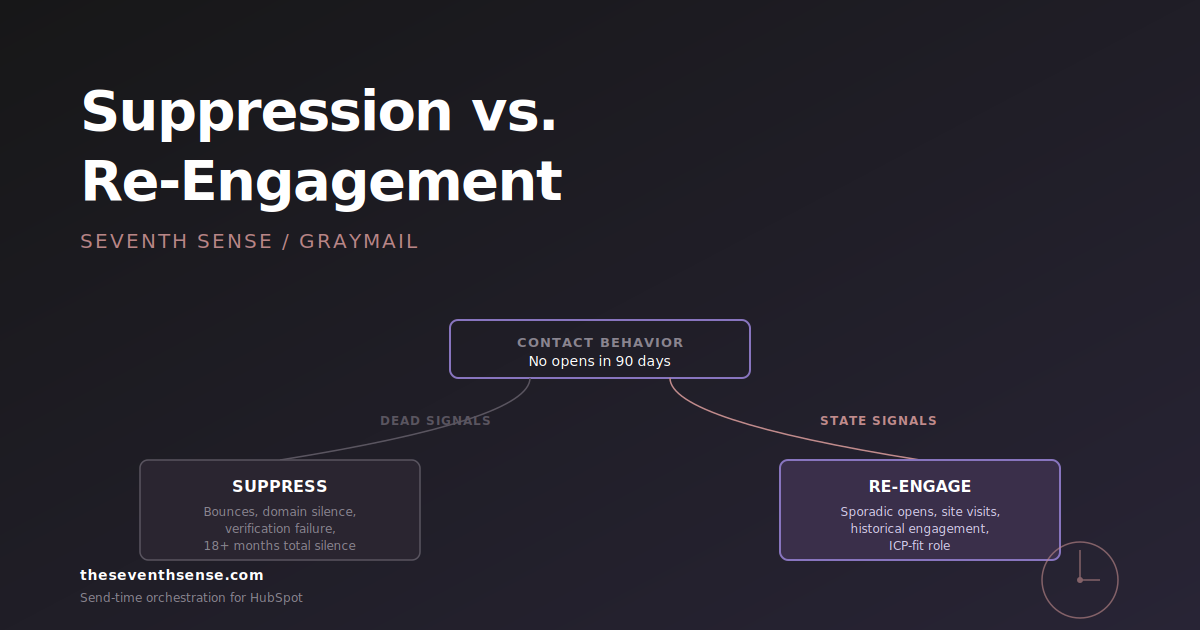
Suppression is the right move for a specific, narrower set of contacts than most teams suppress. The signals that justify it:
- The contact has bounced repeatedly. Hard bounces, especially "user does not exist" responses, mean the contact has left the company or the address is gone. Suppress immediately and don't waste re-engagement attempts.
- The contact's domain shows widespread silence. If you have ten contacts at a company and none of them have opened in the last year, that's a company-level signal, not a contact-level one. The company may be defunct, may have migrated email systems, or may have moved out of your ICP entirely. Suppress at the domain level.
- The contact has zero positive engagement across 18+ months. No opens, no clicks, no site visits, no form fills, no sales-touch responses, no event registrations. After 18 months of complete silence across multiple re-engagement attempts, the suppression decision is earned — and only earned then, which is why the 90-day HubSpot inactivity rule suppresses too aggressively.
- Email verification has flagged the address as risky. A periodic verification run will catch addresses that haven't bounced yet but are unlikely to deliver successfully. Suppress these proactively.
Notice what's not on this list: "didn't open the last campaign." The Hygiene Hawk treats that as a suppression trigger; the Patient Operator treats it as a tier-down trigger.
When re-engagement wins
Re-engagement is the right move for the much larger population of graymail contacts who are quiet for reasons other than the relationship being dead. The signals here:
- The contact opened recently but doesn't open consistently. Sporadic opens are a buying-cycle signal, not a graymail signal. These contacts are likely in a "not now" state, not a "never" state.
- The contact engages with the site even if not the emails. A contact who visits your pricing page but doesn't open your nurture is showing you exactly which channel to invest in. Re-engagement should focus on the channel they're actually using.
- The contact was high-engagement historically. Past behavior is the single best predictor of future behavior. A contact who opened 80% of your sends two years ago and now opens 10% has gone quiet for a reason that's probably reversible — the engaged vs. never-engaged split is the cleanest way to surface these contacts.
- The contact is in an ICP-fit role at an ICP-fit company. Even with low engagement, an ICP-fit contact has higher option value than a non-ICP contact who opens every email. Re-engage the ICP fit first.
The principle: graymail is a state, not a verdict. States can change. Verdicts are final. Suppression treats every graymail contact as a verdict; re-engagement treats them as a state.
The decision framework
Here's the framework I run through with HubSpot teams when they're sitting on a graymail report and trying to decide what to do.
Step 1: Strip out the obvious suppressions first
Run the bounces, the domain-level silence, the verification failures, and the 18+ month complete silence through a one-time suppression workflow. This is usually 15-25% of the graymail population in a typical B2B portal. Get it out of the way so the rest of the framework operates on the contacts that actually have option value.
Step 2: Tier the rest by recency and intensity of past engagement
Score the remaining graymail contacts by how recently they last engaged and how intense their historical engagement was. The top tier — recent engagement, historically intense — gets aggressive re-engagement with high-quality content. The middle tier gets a slower, segmented re-engagement campaign matched to original interest. The bottom tier goes into a low-frequency win-back pool and gets one carefully chosen send per month.
Step 3: Match content to original source
Re-engagement campaigns built around the original content interest convert at three to five times the rate of generic "we miss you" emails. A contact who came in through a webinar on integrations should get an integration-themed re-engagement; one who came in through a pricing page download should get a pricing-themed one. This step is the operational work that most teams skip, and it's the one that decides whether re-engagement actually recovers pipeline.
Step 4: Set a six-month review
The re-engagement pool isn't permanent. Contacts who don't respond after six months of segmented re-engagement plus low-frequency win-back are the ones who finally earn the suppression decision. Run the review on a calendar, not on a dashboard alert, because you don't want a quarterly metrics scare to trigger an early suppression of contacts who would have come back in month nine.
Frequently asked questions about graymail suppression in HubSpot
How does HubSpot define a graymail contact?
HubSpot's graymail report flags contacts who have been on the list for a meaningful period without opening or clicking, but the exact threshold is configurable. The default behavior surfaces contacts who haven't engaged in the last 6-12 months, but the report is a recommendation engine, not a suppression mechanism — you decide what to do with the surfaced contacts.
Will Gmail and Outlook send my emails to spam if I keep mailing graymail contacts?
They might, but the cause is the ratio, not the absolute number of graymail contacts. If your overall positive-to-negative engagement ratio stays healthy, you can keep mailing graymail contacts at a reduced cadence without provoking spam placement. If your ratio is already poor, even moderate sends to graymail contacts will accelerate the drop.
Should I run re-engagement campaigns through HubSpot workflows or through a separate tool?
HubSpot workflows are the right home for the campaign itself. The piece that's hard to do in HubSpot natively is the tiering and the cadence-by-tier orchestration — that's where dedicated engagement-scoring tools earn their place, because they automate what otherwise becomes a weekly manual ops task.
How long should I run a re-engagement program before suppressing non-responders?
Six months minimum for the segmented re-engagement plus low-frequency win-back combination. Twelve months is better for B2B with long buying cycles. The pipeline recovered in months 7-12 is usually 30-50% of the total program recovery, so cutting the program short at six months leaves significant pipeline behind.
Where to go from here
The choice between graymail suppression and re-engagement isn't an all-or-nothing call. It's a sorting problem where roughly 20% of your graymail contacts genuinely belong on the suppression list and the other 80% belong in some form of re-engagement loop. The teams that treat the choice as binary — either suppress everyone or suppress no one — pay for it either in deliverability or in lost pipeline.
Seventh Sense automates the sorting work that makes this framework operationally sustainable. Engagement scoring tells you which graymail contacts have option value worth preserving and which don't. Send-time precision improves the open probability on the re-engagement campaigns, which is where the bottom-tier graymail recovery hides. The free trial connects to your HubSpot portal in about 15 minutes and runs the classification on your real graymail list, so you can see exactly how many of the contacts you were about to suppress are recoverable.
Suppression is permanent. Re-engagement is reversible. Default to the reversible move and earn the permanent one.
See what your email program could be doing.
Connect Seventh Sense to your HubSpot portal and watch the AI surface per-person engagement profiles, per-inbox-provider performance, and AI-driven optimization recommendations - within 24 hours.
Try it free →