I sat in on a campaign post-mortem a few months ago for a B2B SaaS company whose Q1 nurture sequence had landed flat. Their open rate was 21%, almost identical to the previous quarter's 22%. Their CTR had dropped from 4.1% to 2.8%. The team spent 45 minutes debating subject lines and CTA copy. None of them mentioned the only number that mattered: the first hour engagement email share had collapsed from 58% to 19%. The campaign hadn't gotten worse. The timing had gotten worse, and the open rate was hiding it.
In my experience, almost no B2B marketer looks at first-hour engagement until something forces them to. It's the metric that explains why two campaigns with identical open rates can produce completely different revenue. Once you start looking at it, the open rate stops being the question you ask.
What the first-hour engagement window actually is
The first-hour engagement window is the 60 minutes immediately after an email is delivered to a recipient's inbox. For most B2B audiences, the share of total engagement that happens inside that window — opens, clicks, and downstream conversions — is dramatically larger than what comes later.
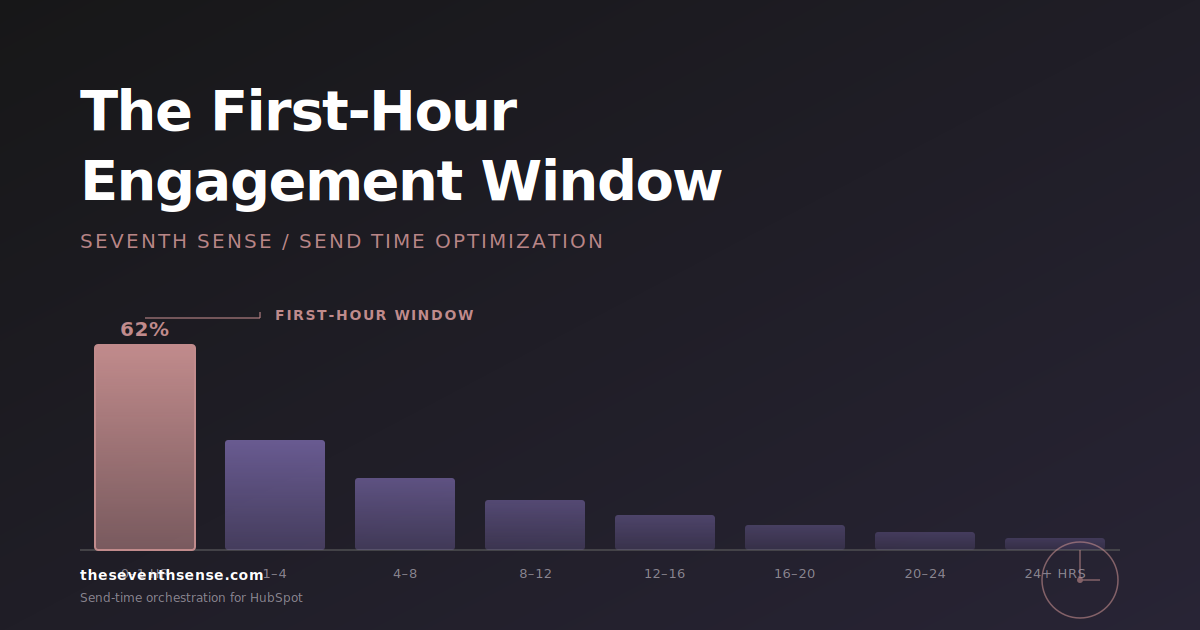
The shape of the engagement curve, plotted against time-since-delivery, looks like this for a typical B2B campaign sent at a well-matched time:
- First 60 minutes: 50–70% of total opens.
- Hours 1 to 4: Another 15–25%.
- Hours 4 to 24: Another 10–20%.
- After 24 hours: Under 10%, mostly stragglers and bot prefetch.
The curve is steep. It's not a normal distribution; it's an exponential decay with a sharp first-hour peak. Every hour you delay relative to the recipient's window, you're moving down a steep slope, not a gentle one.
Why open time matters more than open rate
This is the part that takes a minute to internalize. Imagine two campaigns to the same list:
- Campaign A: 24% open rate. 65% of those opens happen in the first hour.
- Campaign B: 26% open rate. 22% of those opens happen in the first hour.
Which one is the better-performing campaign? If you said B, you read the open rate and stopped. The honest answer is A, by a wide margin, and the reason is what happens after the open.
An email opened in the first hour was opened because the recipient was actively in her inbox, attention engaged, with time to read. The click-through rate on those opens runs 2–3x higher than opens that happen 6 hours later. The downstream conversion (form fill, reply, demo booked) on those clicks runs 2–3x higher again. The compounding means a first-hour open is worth roughly 4–9x as much as an open that happens later in the day. That's not a small difference. That's the difference between a campaign you'd run again and one you'd quietly bury.
Open rate weights every open equally. First-hour engagement weights every open by how much it was actually worth. This connects directly to the broader argument that email latency is the metric platforms are hiding — first-hour share is the simplest summary of the latency distribution.
What happens to the emails that miss the first hour
The mental model most marketers carry is that an email "ages out" gradually — that an open at hour 6 is worth a bit less than an open at hour 1, but not dramatically. The data doesn't support this. The decay is sharp, and there's a specific reason: inbox geography.
An email that arrives at the wrong hour gets buried under everything that arrives between then and when the recipient next checks. By the time she actually opens her inbox, your email might be the 14th unread item, behind a Slack notification, a calendar invite, and three other senders. She might open it. She might not. Even if she does, she's in batch-clearing mode — processing inbox debt, not actually reading. The behavior of an open-at-hour-6 is fundamentally different from the behavior of an open-at-minute-12. This is the same dynamic that makes several HubSpot email metrics misleading in their default form — they count the open without weighting the moment of attention.
This is why STO that targets the right window matters more than STO that just hits "any time the recipient will open." Hitting any open is easy. Hitting the open that drives the click and the conversion requires being there during the first-hour window specifically.
Why send-time optimization that misses the first hour is barely STO at all
Here's the connection. A lot of send-time optimization, particularly the campaign-level kind, is optimizing for "will the recipient eventually open this?" rather than "will the recipient open this in her first-hour window?" Those are different optimization targets, and they produce different scheduling decisions.
If you're optimizing for eventual open, you can hit reasonable open rates by sending whenever your platform thinks the recipient is "likely" to check her inbox. That might be 7 AM, when she clears overnight email in 90 seconds while pouring coffee. The open registers. The engagement doesn't.
If you're optimizing for first-hour open, you have to schedule for the specific moment the recipient is most likely to be in her inbox and paying attention. That's a much narrower target. For some recipients it's 10 AM, for others 2 PM, for others 6:45 AM during their pre-meeting catch-up. The point is that this window is per-recipient and tight, and missing it by even an hour costs real engagement.
This is the principle that matters: your send time isn't optimized until first-hour engagement goes up. Open rate is a lagging, weighted-wrong proxy.
How Seventh Sense tracks first-hour engagement
In October 2025, we shipped Email Latency Metrics, which included first-hour engagement as a first-class reported metric. Every campaign's dashboard shows the share of opens that happened in the first 60 minutes, broken out separately from total opens, with the latency distribution underneath. The reason we surfaced it this way is that customers using our AI scheduler were seeing the lift in first-hour engagement before they were seeing it in overall open rate — first-hour numbers respond faster because they're more sensitive to timing changes.
The AI scheduler itself optimizes specifically for first-hour engagement, not just for "any open." The per-recipient model predicts not just whether the recipient will open the email, but the window during which she's most likely to open and engage with intent. The schedule built from that prediction is denser around real engagement windows and sparser around inbox-clearing windows. Open rate goes up; first-hour engagement goes up more.
How to diagnose your campaigns using first-hour data
If your platform exposes first-hour share, here's the diagnostic pattern I'd run on your last 10 campaigns.
Healthy: first-hour share above 50%
Your sends are landing close to recipient windows. The campaigns that drove the most engagement should also have the highest first-hour share — that's the consistency that tells you the timing is working.
Mixed: first-hour share 25–50%
You're catching some recipients in their window and missing others. If your list is time-diverse (multiple regions, mixed personas), this is the signature of campaign-level scheduling on a list that needs recipient-level scheduling.
Low: first-hour share under 25%
Your campaigns are landing at times when most of your list isn't actively in their inbox. Even if total open rate looks acceptable, downstream conversion is going to be soft. This is the pattern that should trigger an STO rebuild — the open rate is masking that you're missing the engagement window almost entirely. (Keep in mind that Apple Mail Privacy Protection can pre-fetch opens at non-human times, smearing the curve in ways that aren't really about timing — click-based first-hour share is the cleaner signal for high-Apple-share lists.)
The compounding effect of first-hour engagement on deliverability
There's one more thing first-hour engagement does that open rate doesn't, and it's the part with the longest tail. Mailbox providers don't just track whether your emails get opened — they track how quickly. Fast, consistent first-hour engagement is the single strongest positive signal you can send to a mailbox provider. It tells Gmail and Outlook and Yahoo that your sender is producing email that recipients actually want to read, immediately. Google's Postmaster Tools exposes the reputation outputs of this loop directly to senders who monitor it.
The compounding effect is that high first-hour engagement improves your sender reputation, which improves your inbox placement, which improves your future first-hour engagement (because more emails land in the inbox where the recipient sees them quickly), which improves reputation further. It's a positive feedback loop that takes weeks to build and weeks to lose.
The inverse is true too. A long stretch of campaigns with low first-hour share degrades your reputation steadily, and you won't notice it in open rate until the cumulative damage is large enough to drop your inbox placement noticeably. By that point, you're recovering from a reputation hit, not just retuning a timing model.
Frequently asked questions about first-hour email engagement
What's a good first-hour engagement share for a B2B email campaign?
For well-timed B2B campaigns, 50–70% of opens should happen in the first hour. Above 70% is exceptional, usually only seen in tightly time-clustered audiences. Below 30% indicates timing problems that open rate alone won't surface.
How is first-hour engagement different from open latency?
They're related but distinct. Open latency is the time from delivery to first open, measured for each individual open (so you can compute mean, median, distribution). First-hour engagement is the share of total opens that fell into the first 60 minutes — a single percentage per campaign. The latency distribution is the full picture; first-hour share is the simplest summary statistic.
Can I measure first-hour engagement in HubSpot natively?
HubSpot exposes engagement timestamps in the contact's event timeline, so the data is technically available. But there's no native report that surfaces first-hour share per campaign. Most teams either build a custom report against the events API or use a tool like Seventh Sense that surfaces it directly.
Does first-hour engagement matter for transactional emails?
Less so — transactional emails have near-100% first-hour engagement by design, because the recipient is actively waiting for them. The metric is most useful for marketing emails, where timing is a real lever you can pull.
Where to go from here
The fastest way to understand where your email program actually stands is to look at first-hour engagement on your last 10 campaigns. If it's high and consistent, your timing is working and the next lever is content. If it's low or volatile, your open rate is hiding a problem that's getting worse, not better.
The free trial of Seventh Sense surfaces first-hour engagement as a standard metric and runs against your historical HubSpot data. You can see your current first-hour share within minutes of connecting — before sending anything new. That number is the most honest diagnostic of your STO that exists.
Open rate tells you the campaign sent. First-hour engagement tells you it landed.
See what your email program could be doing.
Connect Seventh Sense to your HubSpot portal and watch the AI surface per-person engagement profiles, per-inbox-provider performance, and AI-driven optimization recommendations - within 24 hours.
Try it free →